Keep VMware, run it alongside Proxmox VE for a while or replace it entirely? Applications, contractual commitments and a tested way back come first. Adding another platform does not by itself create resilience. This decision matrix combines business acceptance stop conditions with a transparent three- and five-year calculation.
The example is hypothetical: a company runs three hosts, each with two occupied CPU sockets and 24 cores per socket. VMware vSphere Foundation (VVF) therefore requires 144 physical cores to be considered; Broadcom’s stated minimum of 16 cores per CPU is met. A Proxmox VE Standard subscription covers six sockets here. The three approaches meet the same requirements only if applications, recovery objectives, backup, networking, storage and support scope are checked separately.
Three approaches, three specific triggers
| Approach | Suitable when … | Evidence required before approval |
|---|---|---|
| Keep VMware | a critical application or operational process currently depends on verified VMware features | a suitable contractual offer, tested backup restoration, support route and date for reassessment |
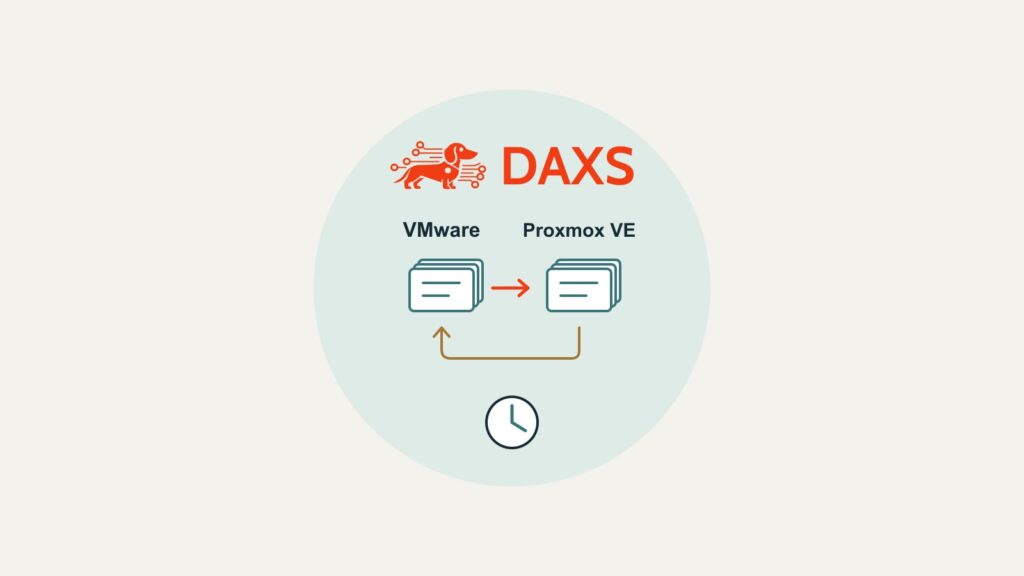
| Run both temporarily | several VM groups need to move in sequence with measurable acceptance criteria | capacity for both platforms, clear data authority for each application, an end date and overlap costs |
| Replace entirely | drivers, integrations, restoration and business application tests have passed and the contract permits the move | a pilot, documented maintenance window, a way back before new production data and operational expertise |
For a small, manageable VM estate, a tested complete move may reduce duplicate operation. For a midsized business with many dependent applications, a limited migration wave is often easier to verify. A special case such as vTPM, encrypted VM disks or a vSAN-backed import may block the direct route; the Proxmox migration documentation describes specific limitations. Targeted adjustments, another migration method or retaining VMware for now remain options. This assessment supports a decision; it is no promise about a particular environment.
What does one year of parallel operation cost in the model?
The manufacturer lists Proxmox VE Standard at €550 per occupied socket per year, giving €3,300 here. One Proxmox Backup Server with a Standard subscription is budgeted at €2,240 annually. For VMware, q remains the actual VVF quote per licensed core per year; b is the suitable annual backup solution. Both amounts remain open. Internal effort is assumed at €90 per hour: 60 hours annually when retaining VMware, 80 after the move and 100 in the first parallel year. One-off costs are €2,000 for contract and acceptance work when retaining VMware and €15,000 for migration, testing and acceptance under either migration approach.
Under the parallel approach, both complete platforms run in the first year. All suitable VMs then run on Proxmox VE. H represents additional net costs for the necessary parallel hardware, storage and network capacity. RP represents remaining payments for VMware and its backup after the first year if contracts run longer; RW represents equivalent remaining payments under the direct move. Set these variables to zero only after checking contracts and planning capacity. Identical hardware costs across the three approaches are excluded. The direct approach assumes usable transition capacity without extra purchases; if unavailable, it also needs its own hardware line. Different replacement, electricity and housing costs belong in H or an additional line.
| Approach | Three years | Five years |
|---|---|---|
| Keep VMware | 18,200 € + 432q + 3b | 29,000 € + 720q + 5b |
| One year in parallel, then Proxmox | 55,020 € + 144q + b + H + RP | 80,500 € + 144q + b + H + RP |
| Directly to Proxmox | 53,220 € + RW | 78,700 € + RW |
The first parallel year is calculated as 144q + b + 3,300 + 2,240 + 100 × 90. Each subsequent Proxmox year costs 3,300 + 2,240 + 80 × 90 = €12,740 in the model. Thus 15,000 + (144q + b + 14,540) + 2 × 12,740 = 55,020 + 144q + b over three years; over five years there are four rather than two Proxmox-only years. A direct move gives 15,000 + 3 × 12,740 = €53,220. Retaining VMware gives 2,000 + 3 × (144q + b + 5,400) = 18,200 + 432q + 3b. Under these assumptions, parallel operation costs more than moving immediately. Its purpose is a limited transition with verifiable acceptance; it must not become an indefinite dual platform.
The sensitivity is clear: if the VMware quote rises by €10 per core per year, three-year costs increase by €4,320 when retaining VMware and by €1,440 under the one-year parallel approach. Each further commitment beyond the first year increases RP by the amount contractually owed. If capacity for both platforms already exists, H may be small; failure reserves and performance on both sides must still be demonstrated. Without that evidence, H = 0 would be wishful thinking. A listed price also does not establish equivalent backup, support or functionality.
Four approvals for the decision
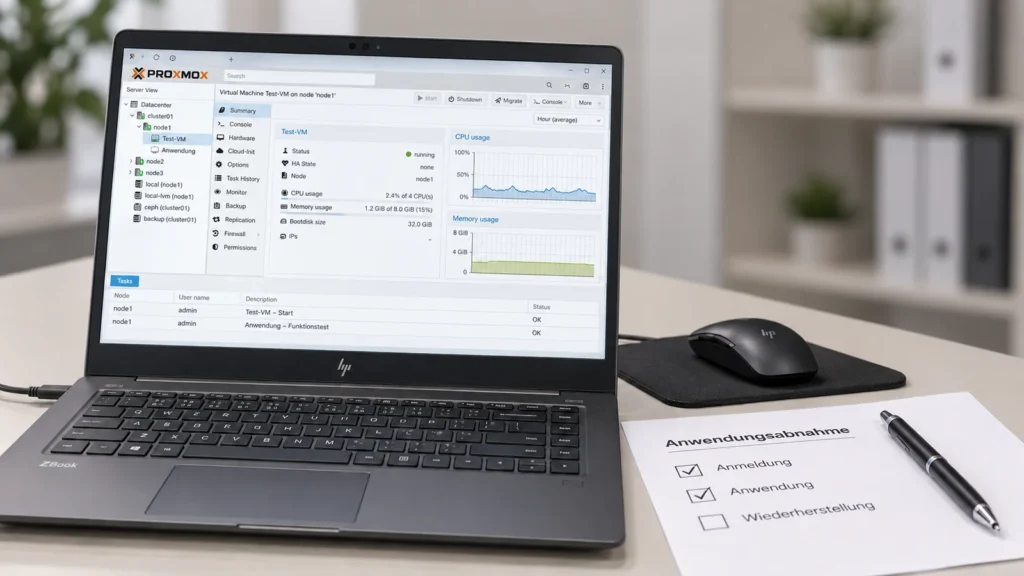
Contract: Which product edition, core quantity, minimum term and notice period are confirmed in writing? Technology: Can the relevant VMs be restored together with networking, storage, drivers and backups? Business acceptance: Does the application pass testing with real workflows, beyond merely booting? Operations: Who handles monitoring, updates, on-call arrangements and the way back? The published DAXS article From VMware to Proxmox: accept the application first explains business acceptance testing.
DAXS can work with the IT team to turn the inventory, contract and quote values and approvals into a concrete decision sheet. For support, use our contact page. Only verified variables turn this model into a reliable basis for a decision.
Sources: Proxmox VE: subscription prices and socket rules · Proxmox Backup Server: subscription prices · Broadcom: VVF core counting and minimum per CPU · Proxmox: documented import limitations.