An inexpensive graphics card does not by itself make an inexpensive AI service. Conversely, a cloud solution costs more than its token rates alone. An open comparison over 36 months shows which purchase, electricity, support and usage assumptions make the difference.
Define the task before the cost line
In this example, approved notes are to become short text drafts. A useful comparison needs defined quality, permitted data flows, context length, waiting time and concurrent usage. A small local model and a cloud model do not automatically deliver equivalent performance.
The following amounts form an illustrative calculation. Verified API list prices are separated from freely chosen planning assumptions. The cost lines are not quotations and do not demonstrate equal capacity or output quality. All recurring comparison values are net amounts or calculated costs.
What does your own server cost over 36 months?
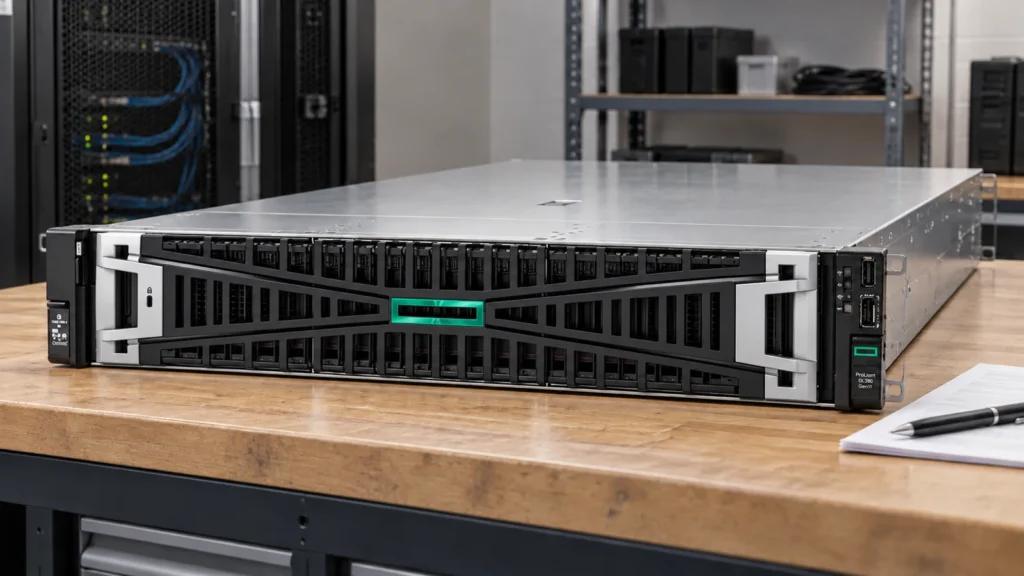
We assume an initial net budget of 17,800 euros: 14,500 euros for hardware, 1,500 euros for three years of hardware service and 1,800 euros for setup. With assumed Austrian VAT of 20 %, this initial budget block totals 21,360 euros including VAT. The actual tax treatment is determined for the specific transaction.
For the economic calculation, we spread the 17,800 euros over 36 months. This includes the assumed hardware depreciation period; it does not establish a tax depreciation period. The monthly figure is a calculated value, not a monthly financing instalment.
| Item | Euros/month | Assumption |
|---|---|---|
| Initial budget / 36 | 494.44 | 17,800 euros including setup and three years of hardware service. |
| Electricity and environment | 54.75 | 250 W on average, throughout the year, 0.25 euros/kWh net and factor 1.20. |
| Administration | 200.00 | Two hours at a calculated 100 euros. |
| Backup / monitoring | 20.00 | Additional monthly allowance. |
| Reserve | 30.00 | For parts or work not covered. |
| Total | 799.19 | Unused capacity remains part of the calculation. |
The energy assumption is: 0.250 kW average total power draw × 8,760 hours/year × 0.25 euros/kWh net × factor 1.20 for additional environmental requirements ÷ 12. This gives 54.75 euros per month. The factor is a separate assumption for cooling and the environment, independent of VAT.
For a real calculation, measure the whole system at idle and under load. The electricity rate used must reflect the business’s actual energy, network and levy components. This example does not claim to use a current average Austrian tariff.

The API calculation needs usage and a tariff
The dated provider example is OpenAI GPT-6.1 Sol on the Standard short-context tariff: 2 US dollars per million uncached input tokens, 2.50 US dollars for cache writes and 10 US dollars per million output tokens. The price list specifies a 10 % surcharge for regional processing where available.
Our calculation assumes 2,000 input tokens and 500 actually billed output tokens per operation. For planning, we conservatively charge all input tokens at the higher cache-write rate of 2.50 US dollars. The normal input rate is not added again. Cache hits, additional tools and retries are not included in this scenario.
10,000 operations therefore produce 20 million input and 5 million output tokens: 20 × 2.50 + 5 × 10 = 100 US dollars. With the assumed regional surcharge, this becomes 110 US dollars. The freely chosen conversion factor of 0.92 euros per US dollar gives 101.20 euros; it is not a verified daily exchange rate.
We then add assumed integration costs of 1,200 euros spread over 36 months, 50 euros of monthly support and 20 euros for monitoring or backup. This base overhead rounds to 103.33 euros per month. With 10,000 example operations, the monthly total is 204.53 euros.
How does increased usage affect costs?
| Operations/month | Input, millions | Output, millions | API usage, euros | API total, euros | Local calculated line, euros |
|---|---|---|---|---|---|
| 1,000 | 2 | 0.5 | 10.12 | 113.45 | 799.19 |
| 10,000 | 20 | 5 | 101.20 | 204.53 | 799.19 |
| 50,000 | 100 | 25 | 506.00 | 609.33 | 799.19 |
| 100,000 | 200 | 50 | 1,012.00 | 1,115.33 | 799.19 |
The local cost line remains mathematically constant in the table. This expressly does not prove that the assumed hardware can handle the load with suitable quality and response times. Higher concurrency, long contexts or a larger model may require additional hardware and support.
The cloud figure also changes if more tokens are billed, additional tools are used or the tariff class changes. Actual usage data is decisive. Visible response length alone is not a sufficient billing measure.
Which assumptions must the pilot replace?
The two hours of local administration at 100 euros each, lower API support effort, power consumption and conversion factor are planning assumptions. After a few representative weeks, observed values can replace them. Necessary specialist review and rework are recorded additionally for both options.
Over 36 months, the local calculation totals 28,771 euros net or calculated costs. It assumes an existing rack, network and suitable site infrastructure. New room fit-out, financing, outage consequences and residual value at the end are excluded. Any additional necessary software licences must be checked and added before the decision.
An existing machine can reduce the additional investment but still carries electricity, maintenance, residual value and committed capacity. Conversely, another API provider, a smaller suitable model, cache hits or appropriate asynchronous processing can change the cloud calculation. Compare the effort per usable result.
Assess technical and organisational suitability together
Approved data flows, internet dependence, response time, adaptability and recovery all belong in the decision. A hybrid model can allocate tasks selectively but also needs rules and support. DAXS assesses local infrastructure and external services against the actual task.
The AI cost optimisation topic page explains model selection and routing. The local LLM infrastructure and the pilot under real load complement the technical assessment. For the broader picture, see the comparison of operating models.
Discuss the AI task, budget and operating model.
Sources: OpenAI: GPT-6.1 Sol rates (external link) · OpenAI: processing classes and surcharges (external link) · E-Control: electricity price components (external link) · USP: VAT rates (external link). All other calculation inputs are explicitly chosen scenario assumptions.