A shared AI service needs more than a graphics card. Its budget includes the server, memory, storage, power supply, cooling and clear operational responsibility. A concrete HPE ProLiant example shows how to calculate these components transparently.
A manageable rack scenario as a starting point
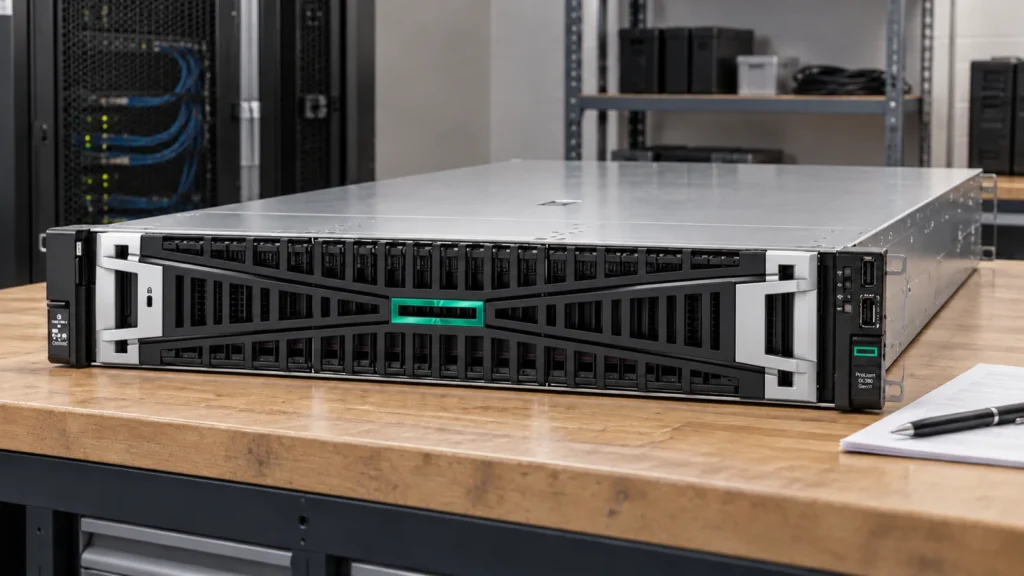
For planning, we assume an HPE ProLiant DL380 Gen11 with one processor, 128 GB of ECC memory and one NVIDIA L4 with 24 GB of graphics memory. The service will process internally prepared text and approved documents. Testing with the actual model and its context length determines how many simultaneous requests it can sensibly support.
Gen11 is a deliberately chosen example platform here. A new purchase would also compare current generations and other suitable systems. The model name alone does not establish which chassis, drive cages and expansion components are compatible.
The exact configuration makes the difference
HPE documentation lists the DL380 Gen11 as a supported platform for the S0K89C L4 accelerator. For this example, we choose an 8SFF chassis with one front drive cage and no rear drive cages. The following table defines the planning basis; a fully validated bill of materials is required before ordering.
| Component | Example assumption |
|---|---|
| CPU | One Intel Xeon Silver 4514Y, 16 cores, 150 W TDP; a suitable Gen11 variant for fifth-generation Xeon processors. |
| Memory | 128 GB using four compatible 32 GB HPE DDR5 ECC RDIMMs. Populate according to the memory rules; this does not fill all eight memory channels. |
| GPU | One NVIDIA L4 24 GB, HPE S0K89C, PCIe Gen4 x16, maximum card power of 72 W. |
| PCIe | GPU in the electrically x16-connected slot 2 of the primary standard riser. No additional secondary riser is planned. |
| Cooling | High Performance Fan Kit P48820-B21; CPU heatsink and airflow matched to the final configuration. |
| Power supply | Two compatible 1,000 W Titanium Flex Slot power supplies, P03178-B21; separately validate operation after one power supply fails. |
| Storage | Two HPE SATA Mixed Use SSDs, P40503-B21, each 960 GB, mirrored, with an MR216i-o controller P47789-B21 and compatible backplane/cables. A separate backup target is planned. |
| Network | A suitable network adapter, including the required OCP connection, within the base budget; coordinate it with the controller and CPU population. |
For the L4, HPE recommends system memory of at least twice the total GPU memory. The assumed 128 GB exceeds the calculated 48 GB for one card. This is sizing guidance; additional services, document preparation and CPU offloading require a separate capacity assessment.
Riser, slot and cooling are assessed together. A mechanically compatible slot may offer fewer electrical lanes. Additional cards or drive cages can change the available mounting position. The final bill of materials therefore also checks brackets, firmware, drivers and vendor approval.
What does a transparent planning budget look like?
The amounts are freely chosen budget assumptions for this worked example, as of 15 October 2026. They are neither a verified reseller quotation nor a price commitment from DAXS. Before procurement, availability and a specific quotation for the full configuration are obtained.
| Budget item | Net allowance | Scope |
|---|---|---|
| Server base | EUR 9,000.00 | Chassis, one CPU, 128 GB ECC RAM, controller and two power supplies; excluding GPU and SSDs. |
| One L4 | EUR 3,000.00 | Approved HPE version of the accelerator. |
| Two SSDs | EUR 1,800.00 | Compatible enterprise versions for the planned mirror. |
| Additional components | EUR 700.00 | Fan kit, rails, brackets and required small parts; avoid counting components twice in the quotation. |
| Hardware service | EUR 1,500.00 | Reserved allowance for three years; check actual service scope and GPU coverage. |
| Setup and acceptance | EUR 1,800.00 | Budget for integration and a limited functional test; agree the scope individually. |
| Net total | EUR 17,800.00 | Sum of the six assumed items. |
| 20% VAT | EUR 3,560.00 | Assumed Austrian standard VAT rate for this example. |
| Total including VAT | EUR 21,360.00 | The tax treatment of the actual transaction is determined separately. |
An existing rack, suitable power circuits, network and backup platform are assumed. A new UPS, air conditioning, operating system/AI software licences, ongoing administration and electricity are not included. A quotation must explicitly resolve these boundaries. Otherwise an apparently inexpensive server price can look more complete than it is.
24 GB of VRAM does not settle the model question
Memory for context, parallel processing and runtime comes on top of model size. A model that works for one short request may create a different load with long documents or several users. The pilot under representative load therefore tests quality, waiting times and headroom together.
Electricity costs also follow the whole system. A maximum GPU rating of 72 W is not a wall-socket measurement of the rack server. Two 1,000 W power supplies likewise do not mean that the service constantly needs 2,000 W. A sound operating-cost calculation measures idle, typical and peak loads.
Plan service, backup and recovery together
A hardware service contract defines specific services for particular components and locations. Response time, service window, parts availability and restoration of the AI service are separate matters. Operations need clear responsibility for fitting a replacement part, checking the software and confirming that the service works for its business purpose again.
The SSD mirror helps when a single drive fails. Accidentally deleted documents, damaged configurations or complete server failure require a separate backup with a tested recovery path. User management, model versions and required service configuration belong in this plan.
DAXS supports assessment, configuration, integration and agreed operations. The local LLM infrastructure guide explains the architecture. The article on Ollama and Open WebUI describes the shared AI service; the HPE guide adds context on infrastructure and support.
Discuss a suitable AI use case and the available budget.
Sources: HPE: DL380 Gen11 QuickSpecs (external link) · HPE: NVIDIA accelerators and platform approvals (external link) · Intel: Xeon Silver 4514Y (external link) · NVIDIA: L4 specifications (external link) · HPE: Tech Care service description (external link) · USP: VAT rates (external link).