VMware or Proxmox VE: which platform makes financial sense for an existing virtualisation environment? Licence prices alone cannot answer that. Comparable functionality, reliable vendor quotations, operating hours and a tested migration path determine the result. The following three- and five-year model makes these items visible without inventing an unverified VMware price.
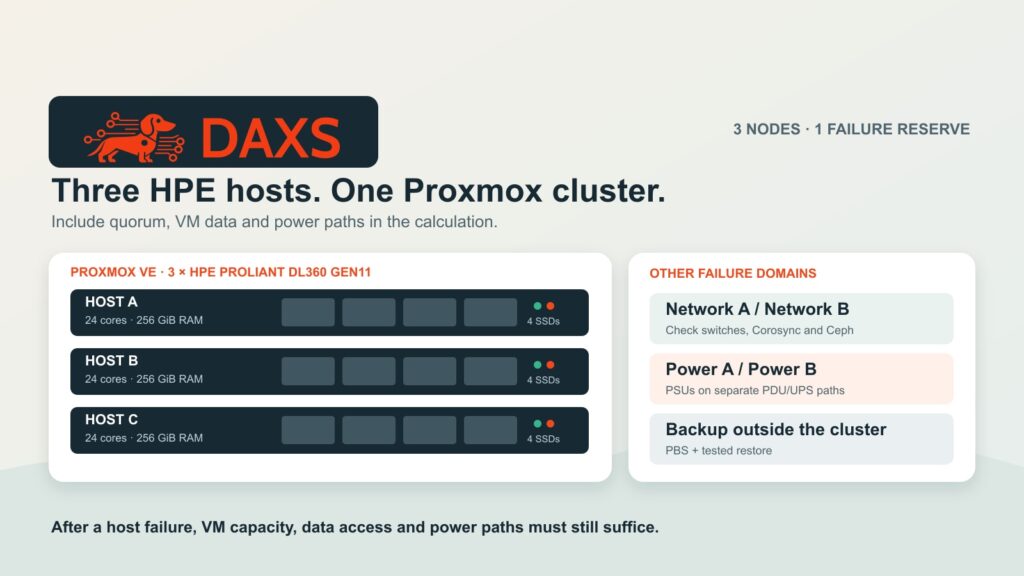
A hypothetical business runs three hosts, each with two occupied CPU sockets and 24 physical cores per socket: six sockets and 144 cores in total. It needs virtual machines, maintenance with minimal interruption, a defined failure strategy and recoverable backups. This hardware configuration is simply a common calculation basis, not a recommendation for a particular server model. For a real comparison, DAXS first needs to assess applications, load, storage, networking, support windows and recovery objectives.
What is actually priced on each platform?
For VMware, the quotation must first identify the exact product. This example assumes VMware vSphere Foundation (VVF) as the comparison option. Broadcom describes physical-core licensing with a minimum of 16 cores per CPU. The 24 cores per CPU exceed this minimum: 3 × 2 × 24 = 144 cores to license. The annual price per core, any minimum purchase quantities, bundle components, support and contract term belong in a current written quotation. A vSphere Standard price cannot be substituted for a VVF price.
Proxmox VE’s core features are available without a paid subscription. If you plan to use the Enterprise repositories and vendor support, calculate the subscription per occupied CPU socket and cluster node. The German price list currently quotes VE Standard at 550 € per socket per year; six sockets therefore cost 3,300 € annually. This is a list price without individual contract terms. If Proxmox Backup Server (PBS) with a Standard subscription is used as a separate backup component, its price list quotes 2,240 € per backup server per year. This model includes one PBS server. Whether that backup architecture meets the existing solution’s functional and operational requirements needs separate assessment. “Proxmox is free” would be an incorrect cost assumption for this support and backup scenario.
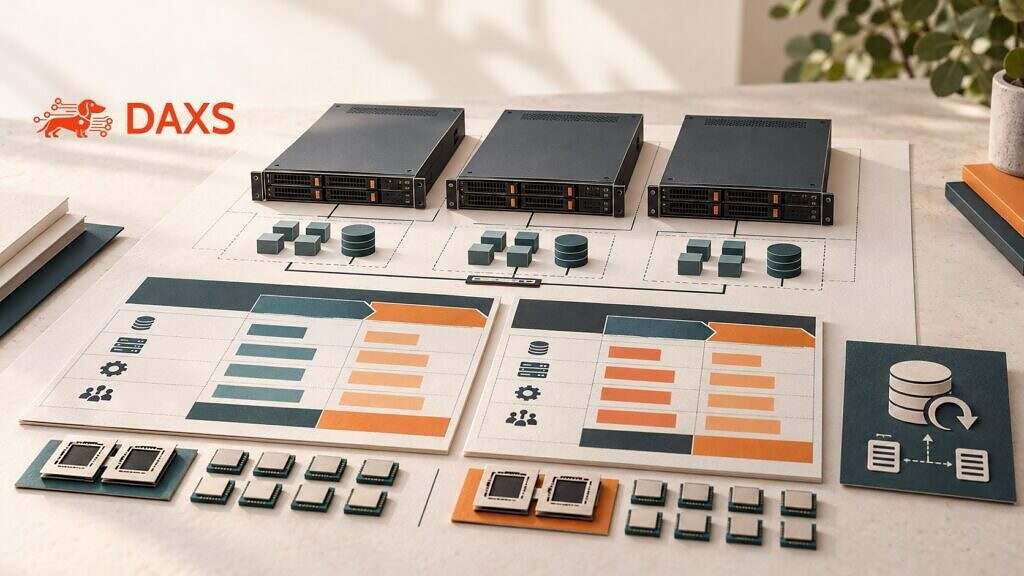
An editable calculation model for three and five years
The following table is a hypothetical planning calculation in euros, not a quotation from DAXS or a vendor. The internal hourly rate of 90 €, 60 or 80 operating hours per year and the one-off costs are explicitly chosen assumptions. q is the actual quoted annual VVF price per licensed core; b is the annual price of the backup solution required for VMware. Both variables remain open until quotations and the scope of services are available.
| Cost component | Proxmox VE + PBS | VMware VVF + backup |
|---|---|---|
| Platform per year | 6 × 550 € = 3,300 € | 144 × q |
| Backup subscription per year | 1 × 2,240 € = 2,240 € | b |
| Operation per year | 80 h × 90 € = 7,200 € | 60 h × 90 € = 5,400 € |
| One-off costs | 15,000 € migration/testing/acceptance | 2,000 € renewal/acceptance |
| Total after 3 years | 53,220 € | 18,200 € + 432q + 3b |
| Total after 5 years | 78,700 € | 29,000 € + 720q + 5b |
This makes the calculation reproducible: Proxmox after three years = 15,000 + 3 × (3,300 + 2,240 + 7,200) = 53,220 €. After five years = 15,000 + 5 × 12,740 = 78,700 €. The VMware side is 2,000 + 3 × (144q + b + 5,400) or 2,000 + 5 × (144q + b + 5,400). A lower-cost option can only be calculated once q and b are supported by actual quotations.
The calculation is sensitive to assumptions: an additional 10 € per core per year increases VMware costs by 4,320 € over three years and 7,200 € over five. An extra 20 operating hours annually at 90 € increases the relevant side by 5,400 € or 9,000 €. In particular, the assumed 80 rather than 60 hours are not a vendor characteristic. An experienced Proxmox team may achieve different figures; a new team must realistically allow for training, troubleshooting and on-call arrangements.
Which costs are missing from this simplified model?
Identical hosts can initially be excluded as common costs. Once an option needs different servers, more RAM, storage capacity, 10/25-Gbit networking, power, colocation or support terms, include the differences. Also assess Windows and application licences, monitoring, security, test environments, external providers, downtime costs and hardware replacement. Migration can involve running both platforms concurrently. The one-off amount above merely assumes a general allowance for this; it is not substantiated.
Validate functionality before comparing prices: live migration, cluster and storage behaviour, permissions, API/automation, backup retention, encryption, recovery and support response times. Proxmox VE integrates virtualisation, clustering and HA features; this does not establish equivalence with a particular VMware installation. PBS likewise does not automatically replace every existing backup function. Restoring a business-critical VM in a test is more meaningful than a feature list. The differences between a successful backup job, verification and recovery are explained in the DAXS article Proxmox Backup Server: verification, retention and recovery.
How DAXS reaches a sound decision
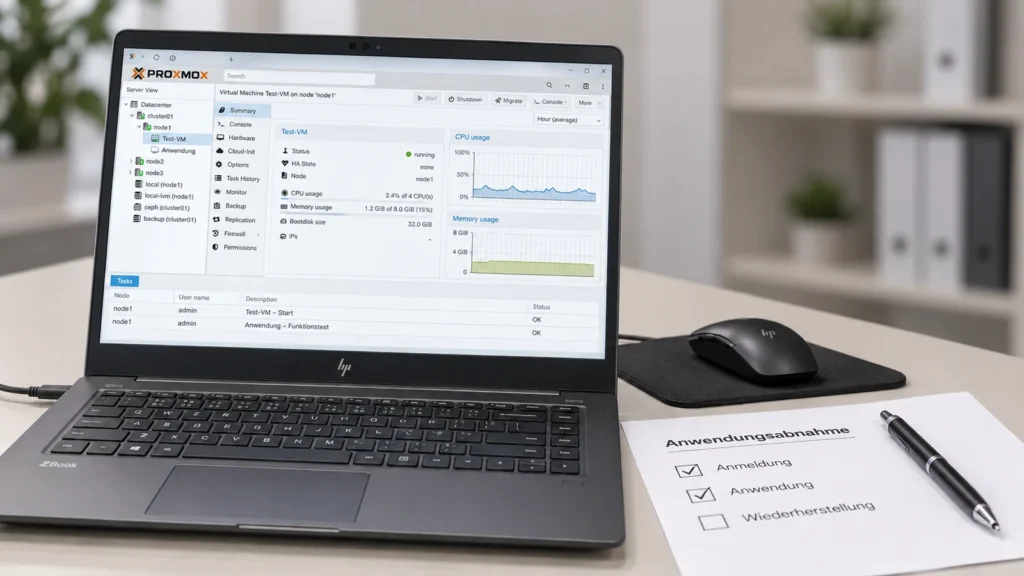
Start with an inventory: CPU sockets and physical cores per host, VMs, peak load, storage, backups, contracts, support and dependencies. DAXS then requests a VMware quotation for the exact product scope required and a suitable Proxmox support model. Together with the operator, DAXS enters realistic hours, migration windows and acceptance tests into the editable table. Three options are possible: retain VMware, run a limited parallel environment or migrate after a successful pilot. The pilot needs a documented rollback path and an application acceptance test. The DAXS article From VMware to Proxmox: validate the application first describes this step; Proxmox for business explains the platform fundamentals.
To work out the figures for your own environment, contact DAXS with your host inventory, current VMware contract and backup requirements via Contact . A sound decision requires matching functionality, price and operating risk for the same applications.
Sources: Proxmox VE: German subscription prices · Proxmox Backup Server: pricing · Proxmox VE: feature overview · Broadcom: core licensing and CPU minimums · Broadcom: separate product terms for vSphere Standard.